Showing posts with label Mt. View Cemetery. Show all posts

Saturday, December 15, 2018

Oakland Urban Paths: Walk of the Dead


After the smoke from the fires up north forced a reschedule, we had a small but "lively" group for the Walk of the Dead. In addition to clearer skies in December, we also had great weather—sunny and not too warm. After talking a bit about customs around death like the Day of the Dead, a brief glossary of terms, and some of the symbols we might see on grave markers, we headed off.

Our first stop was Chapel of Memories, also known as the Oakland Columbarium. It opened in 1901 as an independent business, but now is run by nearby Chapel of the Chimes. The buildings are mostly full of smaller niches. While a few are tagged "before need", most are occupied.

Just up Howe St. is Oakland's oldest existing cemetery, St. Mary's Cemetery, a Catholic cemetery which started a bit before nearby Mountain View Cemetery. There were earlier cemeteries closer to downtown, but as Oakland grew, they got in the way of development. The Oakland Cemetery (1852-1857) was at 8th and Oak. The Webster St. Cemetery (1857-1867) was between Webster and Snow Park. Most of the residents
moved to Mountain View or St. Mary's c.1872-76, but not all:
An excavating machine hit a metal coffin and spilled the contents: “the left hand and arm
nearly to the elbow protruded from the ground, the hand drooped over gracefully from the
wrist. Portions of the coat and vest were visible, as were the outlines of the face, but over these
still rested a coating of fine earth.”
Oakland Tribune April 28, 1877

After a brief stop at 4460 Howe Street, which was home at different times to a superintendent of St. Mary's, a florist, and a granite and marble showroom, we went in the top entrance of Chapel of the Chimes. That took us into the newer areas, but down some flights of stairs and around a couple of corners, and we were into an older part, which was designed by noted architect Julia Morgan. Five different architecture firms worked on the structure over the years. The oldest part was originally a station for the streetcar which stopped at the top of Piedmont Avenue.

From there it was through the gates of Mountain View Cemetery, but into Home of Eternity Cemetery, a Jewish cemetery run by Temple Sinai. They purchased land from Mountain View in 1865. Besides more familiar religious symbols on the grave markers, there we saw some kohanim hands, which mean the person was of the priestly tribe of Aaron. Leonard Nimoy used a modified version of the gesture as the Vulcan greeting in Star Trek.

Stepping past a row of trees took us into Mountain View Cemetery, which at 224 acres, is by far the largest cemetery in Oakland.

First we went into one of several large mausoleums on the Mountain View grounds, which contains the remains of Oakland city council member Frank Ogawa and his family. He and his wife were imprisoned in an internment camp along with other Japanese Americans during WWII. Their daughter, Nancy Lynne Ogawa, was born in the Topaz camp and died there. That mausoleum also contains the remains of my grandparents, my aunt and uncle, and my aunt's father, Dr. Edward Lundegaard. Dr. Lundegaard served as a surgeon in the county coroner's office from 1946 to 1954, and then was elected coroner in 1954.

We wound our way up the hill to "Millionaire's Row", where the likes of "Borax" Smith, mayor Samuel Merritt, and the Crockers of Crocker Bank fame are buried in some sizable and lovely mausoleums. The air quality was better than November, but it was hazy enough it didn't show off the great view. That view, plus the park-like setting (MVC was designed by Frederick Law Olmsted, who designed Central Park in New York City) are part of why people used to visit their grave sites before they needed them, and countless Oaklanders still walk, run and admire the views today.

We finished by the Infant's Plot by the Main Mausoleum, in view of the Pauper's Plot. We didn't have time to continue down Piedmont Avenue and check out the cemetery-related businesses, including florists, grave marker carvers (former), and funeral homes, but we got a nice overview of part of Oakland inhabited mostly by the dead.


Saturday, March 3, 2018

Mountain View Cemetery Black History Month Tour

The following is a guest post by Sarah Wilson. Thanks, Sarah!


Mountain View Cemetery's 2018 Black History Month tour began at 10 a.m., on February 24th, in front of the cemetery's administrative office. I arrived a few minutes early and easily found a place to park. (Free and easy parking is to me as rare and valuable as pirate-treasure.) I saw people walk inside the office, and a woman stood in the lobby with a clipboard. I assumed that the woman was the tour organizer, and if not, a clipboard made anyone look official and attention-worthy. I followed the others up the steps and inside.

I opened the wide door and paused, not wanting to bump another person who stood inside the doorway. I waited as that person moved, and then I slid inside. I felt grateful for the warmth. The sun fell warmly, and I dressed warmly, but not warmly enough. The temperature hovered between 55 and 60 degrees. I wished I had a scarf to add to my long-sleeve shirt, sweater, jacket, and gloves.

"Sign the clipboard to get on our mailing list." The woman lifted her clipboard into the air. My eyes followed the upward movement, but kept going, to the vaulted ceiling. I knew nothing about the architectural style that surrounded us but guessed that it was Victorian, or Gothic. I noticed that behind me stood a miniature model of the cemetery. I noted the tiered layout of the grounds, or the model's way of representing significant changes in elevation. Either way, the cemetery expanded over the nearby hillsides. In fact, the model showed minimal flat ground.

More people arrived outside. Those that stood with me in the lobby were a mix of ages, men and women, black and white. If I were to guess, I would say that there were a few more women than men, and about 30 people total. I anticipated that the tour would begin soon, given the nearness to the hour, and went back outside. I found a sunlit patch of sidewalk and stood and tried to ignore the cold.

"There will be vans, or you can drive yourself, or you can ride with one of us," Lydia said. Lydia was the woman with the clipboard, professionally dressed for a Saturday. She had a scarf, which I envied.
"Can we walk?" Someone expressed what others likely felt -- the expectation that the tour was a walking tour.

"You can, but we will wind our way up and around. You'll have to follow our caravan, and it's quite a trek." I spied the nearest white van with the cemetery logo on the side and edged toward it. "Anna is here," Lydia sang. "Good."

I looked for 'Anna,' but did not see her. Anna blended into the background until she spoke. She did not raise her voice, and the group quieted. Anna introduced herself as a docent and tour-guide. Finished, she moved from where she stood on the steps next to Lydia.

I edged closer to the van, but Lydia said that we had a "stop, just over here." We moved a few yards from the office steps, and Lydia pointed to a stone structure behind her, about 200 yards away. Five or six rows of large, square, stacked sections rose four or five sections high. I did not know the cemetery-term for the structure, which obviously entombed remains. I found out later that the structure was a mausoleum. "The last time we gave this tour, last year, we said that this cemetery was never segregated," Lydia said. "We were wrong. We only just found out the truth, from records we uncovered."

In 1955, or thereabouts, Clara Mae Long, a black woman, intended to lay her husband to rest inside a mausoleum at Mountain View Cemetery. The cemetery denied Ms. Long's request, because that particular mausoleum was set aside for whites. Ms. Long sued, and the resulting case, Long v. Mountain View Cemetery Association (1955), ended in a California Court of Appeal. The Court of Appeal upheld the lower court's ruling, affirming that though Civil Code Sections 51 and 52 ensured all citizens equal access to public accommodations, the law's provisions did not include cemeteries.
However, the presiding judge wrote that he could not resist a word of protest:
"I cannot believe that a man's mortal remains will disintegrate any less peaceably because of the close proximity of the body of a member of another race, and in that inevitable disintegration I am sure that the pigmentation of the skin cannot long endure. It strikes me that the carrying of racial discrimination into the burial grounds is a particularly stupid form of human arrogance and intolerance. If life does not do so, the universal fellowship of death should teach humility. The good people who insist on the racial segregation of what is mortal in man may be shocked to learn when their own lives end that God has reserved no racially exclusive position for them in the hereafter."
I felt uplifted by this story and the judge's sentiment, if not by the Court's decision. I liked that Lydia and Anna chose to bring the story and the judge's assertion to our attention. Others murmured their approval, and someone chuckled at the situation's audacity. On that note, it was time to board the tour-caravan.

En route, our driver explained that the cemetery stretched for 230 acres. That sounded large, but I felt more impressed by the variety of headstones and monuments on display – modest ones, ornate ones, and ones laden with unfamiliar symbols. It took less than two minutes to wind our way up to our first stop, and that timing remained true for the tour's entirety. We visited the grave of local hero Captain William T. Shorey, a.k.a. The Black Ahab, and local legend Bobby Hutton, the first member of the Black Panthers. At each stop, we learned about people who enriched or affected the lives of many and thus, did the same for Oakland's history.

I came away with a sense of what I would like my eulogy to say, a realization I valued. But, in truth, I attended the tour for a purpose. I sought Virginia Prentiss's final resting place and an answer to a question on her behalf: How could Ms. Prentiss, a significant member of Oakland's historic black community and Jack London's surrogate mother, be laid to rest without a headstone?
"Virginia Prentiss was buried here," Anna said, on our third of fourth stop. She gestured to the ground. "Probably about right... there." Anna pointed to the feet of a fellow tour-goer. He laughed and took his cap off and pressed it to his chest.

In that moment, I felt grateful for the cemetery's well-kept records. Otherwise, we simply stood at the top of a hill, under a tree, a few feet from a burial site for Elks-Club members. The rest of what Anna said about Ms. Prentiss, I already knew: that Ms. Prentiss was born a slave in 1832, escaped soldiers of the Civil War, married Alonzo Prentiss, and found her way to California, where she raised her children and became a mother-figure to an icon of American literature. She died in 1922.

I wanted to approach Anna as she stood under Ms. Prentiss's tree, but decided to wait. Just prior to the tour's end, and when I thought I could no longer tolerate my cold-induced sniffles, we found Alonzo Prentiss's grave. Mr. Prentiss lay in the veteran's section, near a Civil War memorial and burial plot.

"Why weren't Alonzo and Jennie Prentiss buried together?" I asked Anna as soon as I saw an opening to approach her, as the tour concluded, and the others departed. Anna shrugged and said something like, no one expects to outlive their children. I remembered then that the Prentiss children died young. So, their plot had room for mother and children only. Then, I asked my big question.

"I know," Anna agreed, "why spend the money on a plot and not include a headstone?" She shrugged. "I don't know the answer."

At that moment a woman with owl-rimmed glasses, who rode in Anna's car from one place to the next on the tour, interrupted us. Unsure that I hid my disappointment in her answer well enough, I left Anna to climb back up the hill with the elk statue at its peak. I shunned the paths for the direct route, wondering about graveyard customs along the way. Was it disrespectful to walk over a grave? Was it poor form to snack in a graveyard? One should not pick a flower that grew in a graveyard, I felt, (though I am not superstitious). I wondered what Ms. Prentiss would think about Black History Month, knowing that she viewed whites as ungodly, given their un-Christian treatment of black people.

I reached the unmarked plot for the second time and felt grateful for the solitude. I took pictures and hoped to share them with other Oakland-history buffs, who may also feel unsettled by Ms. Prentiss's unsung status in the cemetery. I resolved to return to Mountain View Cemetery, perhaps for one of their other tours. I hoped to build on what I knew about Ms. Prentiss:
  • Virginia Prentiss died at around 91 years old, at Napa State Hospital
  • Jack London's will included provisions for Ms. Prentiss's burial expenses
  • Charmian Kitteridge, Jack London's second wife, was the executor of his estate
  • Ms. Prentiss died on Ms. Kitteridge's 51st birthday, in 1922

Thanks to the tour, I learned that the wealth of history that resides at Mountain View Cemetery cannot be overemphasized. Of course, one also cannot overemphasize the wealth of information that resides on the internet, which provided the breadcrumbs that led me to the cemetery. However, the internet lacks a place where you can place your feet on the ground and stand in honor and wonder of what lies beneath. Mountain View Cemetery provides free, bi-monthly tours. Dress warmly, or according to the internet.

Monday, September 15, 2014

Oakland Urban Paths: Julia Morgan


Saturday was a different kind of Oakland Urban Paths walk. Instead of focusing on a single area, we focused on a single person, noted architect Julia Morgan. She's best known for designing Hearst Castle, but she designed over 700 buildings in California, including some noted examples here in Oakland. OUP co-founder Dan Schulman had his work cut out for him in planning the walk, as Morgan's works are spread all over Oakland. About 50 people and quite a few dogs joined us for a longer than normal walk.

We started at the corner of Harrison and Bay Place in Adams Point. Although the building that now houses Whole Foods wasn't designed by Julia Morgan, it has an interesting history, too. It was built as a powerhouse and car barn for the short-lived Consolidated Piedmont Cable Co.'s cable car line (yep, Oakland had cable cars for a time.) Next door the Piedmont Baths used the excess heat from the boilers to heat water for their pools. The building was later redesigned into a car dealership. Dan told us about Julia Morgan's education at Oakland High School, UC Berkeley, and the prestigious École nationale supérieure des Beaux-Arts in Paris, where Morgan became the first woman to receive a certificate in architecture.

Our route took us past a number of Julia Morgan-designed houses, including several with ties to Oakland history. The McElroy House belonged to city attorney John McElroy, who is remembered with a fountain in Lakeside Park. The Joe & Rose Shoong House belonged to National Dollar Store founder Joe Shoong. Shoong and his son were generous with their fortune, and donated to a variety of causes including support for several attractions at Children's Fairyland.

Some people elected to take a shorter route back to our start, while the rest of us headed towards Piedmont Avenue. There we saw a rare example of Julia Morgan's commercial building designs, the Fred C. Turner Shopping Center. From there it was a short walk to the King's Daughters Home. It was designed as a home for incurables, which in those days included people with the infirmities of old age or strokes, as well as those with diseases like tuberculosis that they had no cure for. Julia Morgan donated her work for the design, and after her brother Sam died, Morgan's mother Eliza Morgan donated money for the special front gateway on Broadway.

The official end of our walk was in front of Chapel of the Chimes which Morgan did some design work on, and Mountain View Cemetery, where Julia Morgan and the rest of her family are buried below a modest marker. But a few diehards wanted to see the Morgan grave, so we continued on into the cemetery. We passed by the Ayer and Hockenbeamer graves, which Morgan is said to have designed the markers for, and I pointed out some other notable graves along the way, as well as told people about the Mountain View Cemetery tours given by docents.

Thanks to Dan for leading the walk and doing the needed research, and thanks everyone and everywoof who came on the walk, whether you turned back early or went all the way to the Morgan grave. Next month's walk will be in Butters Canyon, led by local historian and author Dennis Evanosky. More details as they become available.

Some notable Julia Morgan designed buildings in Oakland that we didn't visit (or we'd probably still be walking) include:

Lots more pictures from the walk:


Google map of our route.

Sunday, March 30, 2014

Mt. View Cemetery Tulip Festival


Friday K and I went to Mountain View Cemetery to check out the annual tulip festival. The outdoor displays this year weren't very good. I don't know if they planted too early or too late or what, but the outdoor beds were fairly sparse. The indoor displays are gorgeous and worth the trip, but only run through today (Sunday) at 4pm, so you better hurry!

More pictures from the tulip festival:

Friday, March 28, 2014

painting en plein air


Painting "en plein air" is the fancy French way of saying "painting outdoors". But whatever you call it, I've seen people painting near Lake Merritt, in Joaquin Miller Park, and in Mountain View Cemetery, but this was the first artist I've seen painting outside nearby Chapel of the Chimes.

Speaking of Mountain View Cemetery, they're holding their annual tulip festival this weekend. Whether you check out the special displays in the chapel or just admire the flowers outside on the cemetery grounds, it's well worth a trip to see. Read about last year's tulip festival.

Monday, January 13, 2014

photo of the week: stained glass


OK, technically this is a photo of last week. I was over to Mountain View Cemetery to investigate some Oakland history, and spent some time in the main mausoleum to do some genealogy research to thank others who have done research that I've benefited from. I haven't spent much time in the main mausoleum (seemed boring compared with interesting grave markers), so it was a good excuse to spend some time there. I followed some very detailed directions through the labyrinthine mausoleum and found the info I was looking for. Remembering the adage of the late Galen Rowell, I turned around and saw this lovely view.

Tuesday, November 19, 2013

Mountain View Cemetery: exploring plot 26 and fall colors


Yesterday I spent a while exploring plot 26 in Mountain View Cemetery, doing a bit of genealogical research for someone with a family lot there. Although the day was a bit overcast, there was also some great fall color around the cemetery that really popped when the sun came out.

More pictures from plot 26 (and elsewhere):

Thursday, October 3, 2013

Oakland's Cemeteries - St. Mary's turns 150


You'd expect plot 1 in a cemetery as old as Mountain View Cemetery to have a lot of history, and in that regard, it doesn't disappoint. It's the resting place of a number of people who were instrumental in the shaping of the early town of Oakland, like Solomon Alden, John McElrath, Moses Chase (the first American citizen to settle in Oakland), Enoch Pardee and George Pardee, Jane Waer (the first burial in Mountain View) and many others.

While Mountain View is the biggest cemetery in Oakland, it wasn't the first. It's not even in the top 3. The first cemetery was the Oakland Cemetery, near where Laney College is now. When it was started in 1852, Oakland was a brand new town, and the location was out of the way. But Oakland was growing rapidly, and within 5 years the cemetery was in the way of expansion.

The larger Webster Street Cemetery was started in 1857, but it barely lasted 10 years. Mountain View Cemetery was founded in 1863, but the first burial didn't take place until 1865. Burials stopped at Webster Street in 1867. In preparation for development, most of the remains were moved from Webster Street to other cemeteries. The 'most' part makes it unsurprising that in 1877, an excavator accidentally hit one of the remaining coffins and spilled the contents: "the left hand and arm nearly to the elbow protruded from the ground, the hand drooped over gracefully from the wrist. Portions of the coat and vest were visible, as were the outlines of the face, but over these still rested a coating of fine earth."

The third cemetery to open in Oakland was Saint Mary's Cemetery in 1863. This Saturday, Saint Mary's will be celebrating its 150th birthday with a ceremony and tour. It's a great chance to learn more about this smaller neighbor of Mountain View Cemetery, and learn some Oakland and California history in the process.

Lots more pictures from Plot 1 in Mountain View Cemetery:

Friday, April 12, 2013

photo of the week: tulips!


Aphoto from last weekend's tulip festival at Mountain View Cemetery. Alas, the indoor flower displays were last weekend only, and the warm, dry weather we've been having means the tulip displays outside won't last much longer. At least they'll live on in this photo, which makes a lovely background for a desktop computer or a smartphone.

Tuesday, April 9, 2013

Mountain View Cemetery Tulip Festival


This past weekend was the annual tulip festival at Mountain View Cemetery. I've seen the outdoor displays before, but this was the first time I'd seen the exhibition indoors.

The outdoor displays are impressive, and reason enough to visit Mountain View during the tulip festival. But the indoor exhibition was stunning. Not all the arrangements were to my taste, but they were all pretty amazing. And of course, Mountain View has plenty of other flowers during different parts of the year.

More pictures from the tulip fesitval:

Tuesday, March 26, 2013

Mountain View Cemetery: Women's History Tour


Saturday morning was perfect weather for a walk around Mountain View Cemetery. A large group met there to learn about some of the women buried there, led by Jane Leroe, one of the enthusiastic and knowledgeable volunteer docents at Mountain View.

Jane started with a very brief overview of the cemetery, since some people hadn't been on the general tour. (Those are given every second Saturday; fourth Saturdays are more specialized tours on a wide variety of subjects.) She pointed out the grove of redwoods that marks the "potter's field" where unknown and indigents were buried. Jane also told us about the origin of the word mausoleum. It comes from the elaborate burial monument made for King Mausolus by his wife/sister Artemsia II of Caria. She had the huge Mausoleum of Halicarnassus constructed in his memory. Various well-known Greek sculptors worked on it, along with hundreds of craftsman. It stood about 145 feet tall, and was considered one of the Seven Wonders of the ancient world.

Ellen White Colton - Our first stop was the Colton mausoleum. It's best-known as the interment location of David Douty Colton, who worked with "the Big Four" (Stanford, Huntington, Hopkins and Crocker). But we were there to hear about his wife, Ellen White Colton, who famously sued the Big Four after her husband's death. She was given a lower valuation for her husband's shares than were later given for Hopkins' shares. Although the judge agreed with her in principal, she had agreed to the valuation, so she lost the lawsuit. It did badly damage reputation of the Big Four. Read more about David Douty Colton on Lives of the Dead, which is a great website for learning about the residents of Mountain View.

Miranda Lux - At one point, Charles Lux owned 1/7th of the land in California. When he died, he left half his $20,000,000 fortune to his wife Miranda. She was active in many philanthropic causes, especially schools and aid societies. When she died in 1894, she left a bequest and the Lux Foundation was started. The foundation still exists and is active today, though in 1955 its name was changed to the Miranda Lux Foundation.

Clara Bedell - Clara Bedell was better known as "Diamond Carrie", the owner of a very successful brothel in San Francisco in the 1800s. Her nickname came from her love of jewelry, especially diamonds. She left a sizable estate, but made the news several years after her death when she was listed as the beneficiary of a $10,000 life insurance policy from a judge named R.S. Mesick. Read more about Clara Bedell on Lives of the Dead.

Dr. Chloe Annette Buckel - Chloe Buckel received a medical degree in 1858. When the Civil War broke out, she volunteered her services, but was instead put to work selecting and training nurses. After moving to California, she co-founded a hospital for women and children in San Francisco, and was one of the few female doctors in the state. Read more about Dr. Buckel on Lives of the Dead.

Mary McHenry Keith - Mary McHenry Keith was the first woman graduate of Hastings Law School (where George Pardee, later governor, was one of her classmates), and active in the women's suffrage movement. Read more about Mary McHenry Keith on Lives of the Dead.

Ina Coolbrith - Ina Coolbrith was California's first poet laureate, and also the first librarian in Oakland. She mentored various Oaklanders, including Jack London, who called her his "literary mother". Read more about Ina Coolbrith.

Emma Marwedel - Emma Marwedel was a German immigrant who was the founder of the movement to introduce kindergartens to the U.S. education system. She also founded various schools for vocational training, and trained teachers. Her grave has a geometric granite marker that resembles children's toy blocks. The marker reads "She loved little children". Read more about Emma Marwedel on Lives of the Dead, which also includes a video of docent Jane Laroe.

Sara Lemmon - Sara Lemmon was a botanist who discovered a number of plant species, but is best known for pushing to make the California poppy the state flower of California

Hannah Jayne Adams - Hannah Jayne was Oakland's first school teacher, and later married one of Oakland's big three, Edson Adams. They are buried in large hillside mauosleum labeled "Edson Adams". Read more about Hannah Jayne Adams.

Mary Williams - Mary Williams was better known by her pen name, Kate Carew. She was the only woman illustrator for the San Fransisco Examiner, and was known for her caricatures. Read more about Mary Williams on Lives of the Dead.

Kate Kirkham - Kate Kirkham was the wife of General Ralph Kirkham. When she witnessed a terrible carriage accident and learned the victim had to be transported 10 miles to a hospital, she founded the Fabiola Association, which started Fabiola Hospital to serve the indigent and the poor. The name Fabiola comes from Saint Fabiola, a woman in 4th century Rome who started the first hospital for sick and needy travelers. Read more about Kate Kirkham.

Anna Head - Anna Head founded the Anna Head School, now the Head-Royce School. Read more about Anna Head, and on Lives of the Dead.

Julia Morgan - Julia Morgan was one of the most important Oakland architects and one of the first major women architects. She designed numerous buildings around Oakland and California. Read more about Julia Morgan.

Thalia Treadwell - Thalia Treadwell had a short, tumultuous marriage to cartoonist Jimmie Swinerton. He said the marriage "was not a long one, nor was it civil" and that it fell apart because of "booze and bickering." After studying art in Europe, Thalia returned to the U.S. where she died at age 25 of consumption (tuberculosis). Read more about Thalia Treadwell on Lives of the Dead.

Freda Ehmann - Freda Ehmann is considered "the mother of the California olive industry". Widowed at age 56, she turned a 20 acre olive orchard into the Ehmann Olive Company. She worked with Professor Hilgard of U.C. Berkeley to develop a superior pickling method for olives. Read more about Freda Ehmann on Lives of the Dead.

Mary Swift - Mary Swift was the wife of Franklin Swift, ambassador to Japan, and active in the women's suffrage movement. Read more about Mary and Franklin on Lives of the Dead.

Emily Fish and Juliet Nichols - Mother and daughter lighthouse keepers. Emily Fish married her widowed brother-in-law Dr. Melancthon Fish, and raised Juliet. Juliet married Henry Nichols, a naval officer and lighthouse inspector. After Dr. Fish died, Henry suggested Emily become a lighthouse keeper. She moved her possessions to the Point Pinos lighthouse and a servant, and even brought soil to start a garden. After Henry died, Juliet became the lighthouse keeper at Point Knox on Angel Island. She gained fame when the automatic bell failed during a heavy fog, and she rang the bell by hand for over 20 hours. Read more about Emily and Juliet on Lives of the Dead.

Ella Sterling Mighels - Better known by her pen name, Aurora Esmeralda. Before disparaging her choice of pen names, know that as a child she lived in the town of Aurora, NV, in the county of Esmeralda. She was an author and literary historian; her grave marker is shaped like a giant book, and reads First Historian of "Literary California". Read more about Ella on Lives of the Dead.

Ida Louise Jackson - Ida Louise Jackson was the first African American teacher in Oakland, and attended U.C. Berkeley when there were only 17 African American students. She founded the local chapter of the Alpha Kappa Alpha sorority and was active in in it for many years. She also worked on the Mississippi Health Project which brought health care to rural Mississippi. Read more about Ida Louise Jackson.

There were a number of other graves of note we saw, but I didn't take good enough notes to remember them all.

Lots more pictures from the tour:

Friday, March 15, 2013

photo of the week: shapes


One of my more abstract and favorite shots from my most recent Mountain View Cemetery explorations.

more Mountain View Cemetery explorations


Wednesday I took advantage of the amazing weather and stopped by Mountain View Cemetery. I wanted to find the grave of Chris P. Johnson, founder of the Johnson Electric Washer Co. but I also wanted to check some things out at Saint Mary's Cemetery so I figured I wouldn't stay too long. Um, yeah, about that...

I ran into some friends I know from Habitat for Humanity who were out for a walk with their 10-week old baby in a carrier. We got to talking, and I showed them the map of the cemetery which shows the locations of some of the interesting people buried at Mountain View.

After we parted, I looked at the map to figure out the route to plot 66A, and noticed that I would be going close to the grave for Enoch Homer Pardee, the 18th mayor Oakland and his son, George Pardee, 29th mayor of Oakland and later governor of California. Oh, and Moses Chase is buried nearby. Just one more little side trip...

A few side trips later, I did make it to plot 66A and found the Johnson Grave. The entire plot is markers that are flat with the ground, like in plot 54. In theory, this makes it easier to maintain, as you can just run a lawnmower over everything, but in practice it was found that flat stones have a tendency to sink over time. It also makes it harder to find graves, as from a distance there's nothing distinctive about any of them. Plot 66A is in a lovely area, and though it doesn't have the sweeping vistas of nearby "millionaire's row", the views aren't too shabby.

But then I was off to check on something else I'd seen...a truck with a compressor and sandblaster working on a gravestone nearby. I talked for a while with Dale, the owner and chief of Gateway Memorials. He was mostly done by the time I got there, but I learned a bit about the marking of gravestones. Whether they're working in the shop on a new marker or in a cemetery on an existing one, they use a heavy, slightly adhesive sheet of rubber as a mask. What's not covered gets sandblasted, then painted with black or white paint. It turns out Dale's company also does work in Kaua'i, so it's entirely possible I've seen some of their work when I was there last summer.

I did some more looking around plot 66A, and then realized I didn't have time to go to Saint Mary's Cemetery, too, so I might as well make the most of my time here. I checked the map again to see what other well-known markers I could visit that I hadn't seen before. I went along the row of mausoleums below "millionaire's row".

From there I swung past the Folger (of Folgers Coffee) plot then back to find the mausoleum of David Hewes, who was an associate of The Big Four, and lived for a time at Camron-Stanford House on Lake Merritt. Oh, look, some of the Camrons and the Marshes are just down the hill. And Ina Coolbrith—I think I've seen her grave, but do I have a picture of it?

After only a few more side trips, I eventually left the cemetery. But as usual, I had a few answers, but I had even more questions than when I'd arrived. At least for a change, I'd actually found what I was looking for instead of getting completely sidetracked.

Lots more photos from my exploration:

Sunday, March 3, 2013

more Mountain View Cemetery explorations

The other week after I stopped in Saint Mary's Cemetery I went to nearby Mountain View Cemetery to find the grave of A.K.P. Harmon. Amongst other things, he's known for donating for Cal's first indoor athletic facility, and later, Harmon Gym was named in his honor.

After finding the Harmon grave, I did some more exploring. Mountain View Cemetery is so large that I see new things every time I'm there, even though I've lost track of the number of trips I've made. But I also see things in a new light, sometimes literally. While exploring, I saw the warm afternoon light on the Colton mausoleum. It's the resting place of David Douty Colton, who the town of Colton, California is named for, and probably Colton Boulevard in Oakland, too. He was an interesting sounding man, sometimes referred to as one of "the Big Four and half" because of his association with Crocker, Huntington, Stanford and Hopkins of railroad fame. But other than the possible naming of a street for him and his interment in Mountain View, I don't know of any Oakland connections so I haven't dedicated much time to learning more about him (say, to write an Oakland Wiki entry for him). Regardless, the warm light and the beautiful design made for a lovely image.

More photos from the afternoon:

Monday, February 18, 2013

Mountain View Cemetery: Plot 36


On Friday I made yet another trip to Mountain View Cemetery, because I'd heard that the grave marker for Royal Towns had been located and lifted back to the surface. While there's tons still unknown, the Oakland Wiki entry for Royal Towns is starting to paint a picture of his life. But finding the grave a second time was easy, so I had lots of time after. So I did some exploring in Plot 36, in part to locate the grave of John W. McClymonds which McClymonds High School in West Oakland is named for.

Plot 36 is very different than plot 54. It's older for one thing, but there's a lot more variety in the graves. They range from flat markers like the ones in plot 54 up to one of the more well-known graves, the pyramid-shaped mausoleum of William McKendree Gwin and his family. He (along with John C. Fremont) were the first two senators from the new state of California in 1850.

But there are tons of other interesting markers in plot 36, like the Hoffman/Hollo monument, topped by a lyre and a clarinet. Or the marker for Frank W. Haines (1858-1923), his wife Josephine M. (1867-1933) and Edward E. Haines (1879-1903). The tree-shaped marker with a dove, an ax, and "Dum Tacet Clamat" ("Though silent, he speaks") indicates he was a member of Woodmen of the World, an insurance company that dates back to 1890. There are numerous newer graves, too, like the one for Reginald A. Hayden (1979-2001) who was shot to death at 71st Avenue and Spencer on the 4th of July. Along a picture of Reginald, it reads "beloved son, brother, father, uncle and friend."

There were also some familiar names, like Casebolt Daikin. I've heard that name as the architect of Cielto Lindo, a beautiful Moorish-Spanish style apartment building we saw on the Cleveland Heights and "Borax" Smith urban paths walk. This marker was for Virginia Casebolt Daikin (1836-1926) next to a monument for Frederick H. Daikin (1855-1917). Was there any connection between the architect and these Daikins? It's an unusual name. And back to an earlier question: was there ever a grave marker for John W. McClymonds? Was he even buried there?

There are thousands of more rabbit trails through Oakland history like those that I wish I had time to explore. You can help, by contributing information to the Oakland Wiki.

Lots more pictures from plot 36:

Monday, January 28, 2013

Mountain View Cemetery: Perimeter Tour


Saturday we had perfect weather for a walking tour at Mountain View Cemetery. Second Saturdays there are general tours to give people an overview, and fourth Saturdays there are more specialized tours focused on different subjects. This one was titled "Perimeter", which promised a fair amount of walking because of the size of Mountain View.

The tour was led by docents Stafford Buckley and Barbara Gibson. Also on hand was docent Michael Colbruno, author of the extremely interesting and useful Lives of the Dead website about the people of Mountain View Cemetery.

We started in the chapel in the main mausoleum with a brief overview of the cemetery, its founding and its design. It was founded in 1863 by a group of Oakland civic leaders who met at the house of Dr. Samuel Merritt. It was designed by Frederick Law Olmsted, the noted landscape designer who also designed Central Park in New York.

We headed for the nearest point on the perimeter, with a few interesting stops along the way to note some different mausoleums and graves, including the stately Colton mausoleum. It's the resting place of David Colton, who is sometimes referred to as one of "the Big Four and a half" because of his involvement with "the Big Four" (Crocker, Huntington, Hopkins and Stanford) of California and railroad history. The mausoleum is guarded by a pair of Greek-style sphinxes.

Along the southern perimeter there are several reservoirs, which were created by damming Cemetery Creek (which is known as Glen Echo Greek further downstream). They normally provide water for watering the cemetery grounds for 1 to 2 months of the dry season.

Nearby is one of the unendowed sections of Mountain View. Normally people purchase a plot or mausoleum crypt in Mountain View, which pays for its uptake in perpetuity. People were buried in the unendowed areas with no such promise, but as long as family or friends wanted, they could maintain the grave site. Areas of the unendowed section were also given to a number of charities, like the King's Daughters' Home, a hospital for people considered incurable. That building was designed by Julia Morgan, and still stands at 3900 Broadway.

We also heard about Blair's Park, an amusement park on the border between Oakland and Piedmont. It was created by Walter Blair, who owned property in the area, and featured boat rides, ponies, music and other amusements. Blair also owned the horsecar which brought vistors up the hill from Oakland.

We headed up the hill to see the eastern perimeter, which provided spectacular views of Oakland and the bay. Stafford said that on a clear day from the top of Hill 550 it's possible to see nine Bay Area counties. From the back of the hill you can see areas where many eucalyptus trees were cut down to decrease fire danger, and many, many more redwood seedlings have been planted in their stead.


We walked back downhill along the border shared with St. Mary's Cemetery, and past the influenza plot back to our starting point. As always, lots of interesting stuff to see and learn in Mountain View Cemetery!

Links to some things mentioned:


Lots more pictures from the tour:


After the tour was over, I rode my bike around to check out a few things for the Oakland Wiki and do some scouting for another history focused bike ride that's in the planning stages. And also to get a closer look at the grave of Fred Korematsu.

Even more pictures from after the tour:

Tuesday, May 29, 2012

Memorial Day Observance at Mountain View


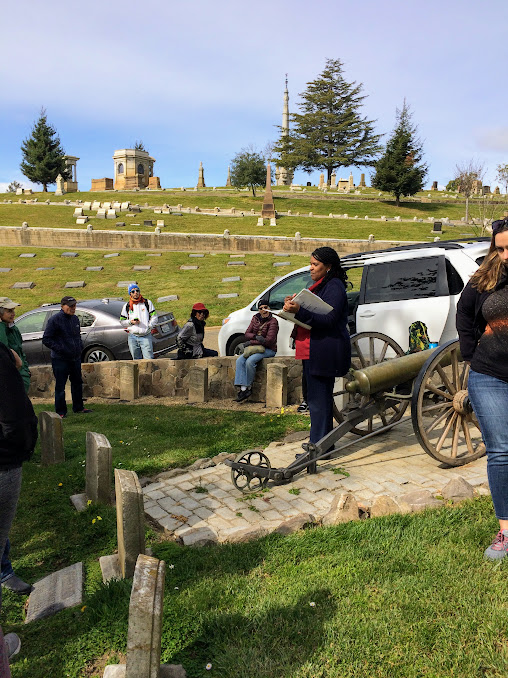
Hundreds gathered in Mountain View Cemetery to remember and honor the soldiers who gave their lives in the service of their country. As people gathered, a brass trio played. After the presentation of the colors, a variety of veterans and active servicemen and women spoke. One speaker called upon people to not only remember the fallen, but to remember and honor vets who've made it home, too, and one way to honor them is to encourage the Veterans Administration to speed up processing of benefits for the vets who need them. The ceremony finished with the placing of a wreath at the veteran's memorial and a 21-gun salute. About 50 people stayed for a tour of the three veteran's plots at Mountain View led by docent and historian, Dennis Evanosky.

More photos:

Thursday, March 22, 2012

Mountain View Cemetery: Flowers

tulips and mausoleum

Oakland flower lovers take note: this weekend is the annual tulip exhibition at Mountain View Cemetery. There are thousands of tulips blooming right now around the grounds of the cemetery. Unfortunately the unusually warm weather followed by storms made them peak earlier than normal, but they're still gorgeous and should be OK through the weekend.

In addition to the tulips around the always-beautiful grounds, there will be a special exhibition in the Tower Chapel between 10am and 4pm, Friday through Sunday. At 1pm each day there will be a special demo.

Even if you aren't interested in the expo, I recommend checking out the grounds while the tulips are in bloom. There are other flowers and trees blooming around the cemetery, too, making it even more beautiful.

And for the taphophiles in the crowd, there are lots of stone 'flowers' around the cemetery, too. While sometimes flowers were selected as decorations simply because people liked them, on older graves they frequently have symbolic meanings, too:
  • tulip - love and passion
  • rose - love, beauty, grace
  • lotus - creation and rebirth; particularly on Egyptian-themed graves
  • Easter lily - purity, innocence
  • lily of the valley - renewal, resurrection
  • evening primrose - eternal love, memory, hope
  • morning glory - departure, farewell, resurrection
  • thistle - Scotland, Scottish
  • daisy - innocence, hope; frequently found on children's graves
  • bellflower - gratitude

Sara Plummer Lemmon

For the history buffs it should all be interesting, but of particular note is the grave of Sara Lemmon. She shares a marker with her husband, John Lemmon, which reads:
partners in botany
the California poppy was named the state flower in 1903 due to the persistent efforts of Sara Lemmon
Unsurprisingly, her marker features a California poppy.

lots more pictures of flowers in Mountain View:


See more Taphophile Tragics posts from the world, and at Oakland Daily Photo here in Oakland for an interesting marker.

Wednesday, March 14, 2012

Mountain View Cemetery: 1918 Flu Pandemic

Last month I was in Mountain View Cemetery again to check out the grave of Captain William T. Shorey, and noted that he died during the 1918-1920 influenza pandemic, or as it's widely known, the Spanish flu. You may also have seen the name grippe, or la grippe.

Kaiser Convention Center

Although Capt. Shorey and his family are in their own plot, there's a section in Mt. View where many Oakland victims of the flu are buried. According to Wikipedia, the three waves of the pandemic killed more than 1,400 people out of 216,000 then living in Oakland, or about 0.65% of the population. For a time, the Kaiser Convention Center (then known as the Oakland Auditorium) was used as a makeshift hospital.

The worldwide toll was staggering. It's estimated that between 50 and 100 million people died in the years of the pandemic, or between 3 and 6% of the world's population at the time. In an unusual twist, most of the victims were healthy, young adults, because the virus stimulated an overreaction from their healthy immune systems. It spread rapidly around the world because of advances in transportation and because of World War I, even as far as the Arctic and remote Pacific islands.

Warren E. Greer

Not all of the people buried in plot 53 at Mt. View are influenza victims, but one was Warren Everett Greer (1880-1919). He married Freida Jund, and they had a son, Everett Greer (who is buried nearby in St. Mary's cemetery). Warren was an accountant, and a Woodman of the World. He would have been about 39 when influenza struck, in the prime of life.

A few of the other gravestones that caught my eye are below. Not all are influenza victims, but there's a native of Australia, some symbols that were new to me, and more. DeMolay International (the crest with the DM, crescent moon and star) is connected to the Freemasons, and past members include Walt Disney, John Wayne, Walter Cronkite, John Steinbeck, and Bill Clinton.


lots more pictures:


Read more about the influenza plot at Mountain View Cemetery, and about some of the more famous victims of the flu at Lives of the Dead. Read some newspaper articles from the period at Oakland Genealogy.

Visit Taphophile Tragics for interesting graves from around the world.