Showing posts with label Cleveland Heights. Show all posts

Monday, February 22, 2016

Oakland Urban Paths walk: Cleveland Heights and Borax Smith


On Saturday we had an overwhelming turnout for the Oakland Urban Paths walk focused on the Cleveland Heights neighborhood and the nearby former home of "Borax" Smith. A record 132 people enjoyed the unseasonably warm weather to learn about this part of Oakland.

We started at the Cleveland Cascade, a water feature on the shores of Lake Merritt, built in 1923. It fell into disrepair, but a group of neighbors has cleaned it up and is raising money to restore it. Keeping our eyes out for gnomes, we wound our way around to the middle of the Haddon Hill neighborhood. It started as an exclusive development in 1912 by Wickham Havens, son of Frank C. Havens.

We had a longer stop at 552 Montclair Avenue. This c.1897 Victorian was built for Judge Edward C. Robinson and his family, including son Bestor Robinson who was law partners with Earl Warren and led the Sierra Club for many years. The house has lots its "witches hat" and been divided into apartments, and the tankhouse has lost its tank and windmill, but it's still a spectacular property.

Our path took us past the Park Community Garden (the artwork I mentioned, "Her Resilience", has been moved indoors for the rainy season) and a couple of murals, including one by Peter Lee. After walking past several beautiful apartment buildings that date back to the 1920s and 1930s, we stopped to talk about "Borax" Smith.

Francis Marion Smith, known as Frank to his friends, and to his consternation, "Borax" Smith to the rest of the world, was a legendary local of Oakland. After making a fortune in borax (used as a cleanser), he invested in Oakland. He was the force behind the creation of the Key System street cars; the Realty Syndicate (where he partnered with Frank C. Havens) developed areas of Oakland and built the Claremont Hotel. His estate was called Arbor Villa; the row of tall palm trees on 9th Avenue marked one edge of the estate. While the grounds and the magnificent Oak Hall were being constructed, Frank and his wife Mary moved into the "old red house" (currently painted green) nearby. The Smiths entertained and hosted fundraising events in a grand style: "The most brilliant affair of the week of course was the reception which Mr. and Mrs. F. M. Smith gave on Wednesday evening at their charming home, Arbor Villa, in East Oakland, to which over 1300 guests from both sides of the bay were bidden." (April 23, 1899 San Francisco Call).

Mary R. Smith was inspired by reading Benjamin Farjeon's Blade O' Grass about orphans in London, and the Smiths took in a number of young girls. Frank gave her some land nearby, and they set up a trust. The Mary Smith Home for Friendless Girls became home to numerous orphaned girls. The girls lived in cottages, each run by a house mother; the older girls helped take of the younger girls. Many of the cottages, including one designed by Julia Morgan, still stand.

Our final big stop was across from the Haddon Hill home of industrialist Henry J. Kaiser. We also looked at some former steps that used to go from the end of Haddon Rd. down to MacArthur Blvd. Those are closed off, and the statue that graced the plinth is long gone.

Thanks to everyone who came out for the walk! The regular second Saturday walk for March 12th hasn't been set yet, but there will be a special walk on Saturday, March 19th, focused on women's history. Check the website calendar for more info, and hope to see you on the paths!


More photos from the walk here.

Monday, February 16, 2015

Oakland Urban Paths: Cleveland Heights and "Borax" Smith


Saturday we had amazing weather for an Oakland Urban Paths walk exploring Cleveland Heights and the nearby former estate of F. M. "Borax" Smith. This was a good follow on to last month's walk in the former town of Brooklyn just south of Saturday's walk.

During the walk I mentioned a Oakland map website that has a series of maps of Oakland, from 1877, 1912, 1936, 1950s, 1967 and present day. It's a great way to see how Oakland has changed over the years. If you look at the 1912 map, you'll see the outline of "Borax" Smith's estate, Arbor Villa. The portion of the map shown here is even older, from about 1869, before Oakland annexed Brooklyn in 1872.

I also promised to provide a map in lieu of the one I didn't have ready for Saturday. Here's a link to a Google map with our route shown, but also some of the points of interest along the way, and as an added bonus, it also shows the approximate bounds of the Smith's Arbor Villa estate and of the Mary R. Smith Home for Friendless Girls.

We started the walk at the Cleveland Cascade, designed by landscape architect Howard Gilkey and built in 1923. It was likely shut down during WWII, but was reactivated after the war. At some point it was turned off, fell into disrepair, and became overgrown and full of trash. In 2004, a group of neighborhood volunteers including Barbara Newcombe uncovered and cleaned up the cascade. Since then they've put in new railings and lighting, and are raising money to restore the water portion of the cascade. If you want to help, the Friends of the Cleveland Cascade has garden work parties on the first Saturday of each month.

From there we meandered across Cleveland Heights, keeping an eye out for gnomes, sidewalk stamps, murals and other things. We eventually crossed over Park Blvd. into the Ivy Hill neighborhood, and what was once the estate of "Borax" Smith, Arbor Villa. While the 42-room Oak Hall, gardens, out buildings and observation tower are all gone now, a row of palm trees marks one edge of what was once the estate. Seeing an old palm tree in Oakland is often a good sign that someone notable lived nearby, but the Arbor Villa palm trees are the best example.

Then it was back across Park Blvd. and along some buildings that are left from the Mary R. Smith Home for Friendless Girls. Frank's first wife, "Mollie", was inspired by Benjamin Farjeon’s Blade O’ Grass about orphans in London, and started an orphanage for girls. One of the "cottages" is an impressive structure at 3001 Park Blvd., which was designed by noted architect Julia Morgan. Our route back to the Cleveland Cascade took us past a home once owned by industrialist Henry J. Kaiser, some stairs at the end of Haddon Rd. that are no longer accessible, and down some beautiful stairs to Beacon St.

Another great walk! Thanks to everyone who came out for the walk, and to Tim for carrying the speaker. In March, we'll have two walks, our regular second Saturday walk (location to be determined) and a special Women's History Walk led by local historian and writer Annalee Allen. Hope to see you there!

Lots more pictures from the route (some taken during the test walk):

Wednesday, January 15, 2014

Oakland Urban Paths: Cleveland Heights and "Borax" Smith


Saturday about 65-70 people and 3 dogs joined Oakland Urban Paths for a walk around Cleveland Heights and the former "Borax" Smith estate near Park Blvd. It was a good crowd, considering the overcast skies and the threat hope of rain.

We started the walk at the bottom of the Cleveland Cascade, what was once a beautiful fountain. A neighborhood group that cleaned up the stairs and fountain in 2004 has added new railings and lights, and is working to raise funds to restore the fountain, too. Even with no water, the stairs are a popular place for Oaklanders to exercise.

At the top of the stairs, we saw where the right of way for Cleveland Street continues. We walked around the block (keeping an eye out for gnomes, sidewalk stamps, and other interesting things) and met up with Barbara Newcombe at the end of Cleveland Street. She was one of the original neighbors that re-discovered and cleaned up the cascade. One of her current projects is working with other neighbors to make a path through the right of way, so people can go directly from Cleveland Street to the top of the cascade and then to Lake Merritt, instead of going around the block like we did.

We walked up and down the hills, past beautiful houses, to Park Blvd. As we walked, people spotted the distinctive row of palm trees across the way. These trees mark the edge of Arbor Villa, the once palatial estate of "Borax" Smith. The trees are one of the last signs of the estate that featured numerous gardens, a deer paddock, a 5-story observation tower, a cattery, and the amazing Oak Hall. Oak Hall had at least 42 rooms including 15 bedrooms, a ballroom, a bowling alley, an attached conservatory, a huge pipe organ, and more.

In Oakland, "Borax" Smith is best remembered for creating the Key System and the Realty Syndicate, which created destinations like the Claremont Hotel and streetcar lines to get people out to see and purchase their real estate. Unfortunately the Key System is gone, just as Arbor Villa is.

Something that still survives in part are the cottages of the Mary Smith Home for Friendless Girls. Smith's first wife, Mary "Mollie" Smith started an orphanage for girls. On land north of Park Blvd., the trust built a number of cottages. Each was lead by a house mother, and had between 8 and 12 girls of varying ages. A number of the cottages are still there, including Evelyn Cottage, which was designed by noted architect Julia Morgan. Also still standing is "The Lodge", which served as the office for the orphanage. The house is privately owned, but still contains the built-in desk and other features left from its days as an office.

We meandered back towards the Cleveland Cascade, through the Haddon Hill neighborhood. There we saw a stairway that has been fenced in and overgrown, and a nearby home once owned by Henry J. Kaiser. Nearby, a beautiful flight of stairs took us to the street behind Our Lady of Lourdes church, and then a short walk took us back to our starting point.

Thanks to everyone and everywoof that came out for the walk. Hope to see you on the next OUP walk, on Saturday, February 8th!

More pictures:

Special thanks to Robert Perricone for the use of some of his photos from the walk.

Tuesday, January 15, 2013

urban paths: Cleveland Heights and "Borax" Smith


Saturday we had an amazing turnout for the monthly Oakland Urban Paths walk. At least 65 people and 7 dogs joined us for a walk exploring Cleveland Heights and the site of the former "Borax" Smith estate. It was a chilly but beautiful morning, and the view over Lake Merritt was breathtaking.

Cleveland Cascade in 1928

We started the walk at the Cleveland Cascade. Designed by landscape architect Howard Gilkey in the 1920s, the cascade had 3 levels of 7 steps each. Each step had a bowl that made a curved sheet of pouring water. At each side were shell-shaped brackets, behind which were lights running through the colors of the rainbow. Over time, the cascade and nearby steps became rundown and overgrown. Barbara Newcombe was part of the original group that helped rediscover and uncover the cascade back in 2004, and was there on Saturday working on the stairs. The Friends of the Cleveland Cascade group has cleaned up and maintained the stairs, installed new railings and LED lighting, and created replica cascade fixtures that will be installed when enough money has been raised. These days the stairs are heavily used, by people walking between Cleveland Heights and Lake Merritt, by people exercising, or just looking to get a different view of the lake. Read more about the Cleveland Cascade from in last year's OUP: Jane's Walk.

We walked up the steps along the Cascade and around to Cleveland Street. Area maps show a right of way between the top of the Cascade and Cleveland Street, but there are no signs that steps were ever built there. The question of "what neighborhood is this?" led to questions about the boundaries of Cleveland Heights, other names for smaller areas within it like Haddon Hill, and the general question of "what's a neighborhood?" The main take-away is that neighborhood boundaries are fuzzy at best. Even though my Oakland Neighborhoods map has clear boundaries, the reality is that it depends on who you ask.

Along our way east, we admired some of the beautiful houses and apartment buildings, pieces of street art large and small, and of course I was checking out sidewalk stamps. They can give clues about the age of a neighborhood.


We crossed over Park Boulevard into Ivy Hill and Bella Vista, which is where the "Borax" Smith estate was. Francis Marion "Borax" Smith made his fortune in borax mining, and coined the slogan "20 mule team borax" which is still in use today. Smith is better known in Oakland for creating the Key System of streetcars. He and his business partner Frank Havens created the Realty Syndicate and bought large pieces of land then sold smaller pieces for development. To get people out to see the real estate, Smith bought up various streetcar lines and combined them into what became known as the Key System. To encourage people to visit, destination resorts like the Claremont Hotel were built. Traces of the Key System can be found all over Oakland, sometimes in subtle ways. Sometimes they're still there, like the Claremont Hotel, and the Realty Syndicate building at 1440 Broadway. We were fortunate to be joined by Dorothy Lazard, head of the Oakland History Room at the main Oakland Public Library who told us more information as we went along.

Further along, we saw another wayfinding mark: a row of palm trees. They mark one edge of the Smith estate, which was known as Arbor Villa. The house itself was called Oak Hall, and was extravagant. It had 42 rooms, including 15 bedrooms; a ballroom; a bowling alley including a ball return; an organ with 18 or more ceiling-height pipes; an attached conservatory; and even a miniature borax mine. The 50-acre grounds were equally impressive, with a 5-story tower with an observatory; a large lily pond; a paddock where deer were kept; stables; several greenhouses; and a variety of guest houses and other structures.

I was inspired by what I'd learned on the Oakland Heritage Alliance "Borax" Smith tour and the bits and pieces I found online preparing to lead Saturday's walk. So Sunday afternoon I joined other like-minded Oaklanders at the Oakland History Room and did more research on Arbor Villa. I've started an Oakland Wiki page about Arbor Villa, and will be updating it as time permits. Other things I learned about where the existence of an archery range, a small man-made cave called "The Grotto", a cattery(!), and various gardens. One information source was the Sanborn maps, which were created to estimate fire insurance rates. So I also found other details like the observatory tower contained a 10,000 gallon water tank.

We crossed back over Park Boulevard, but we weren't done with the Smiths yet. Frank and his wife Mary donated money for the building of the El Campanil at Mills College. Mary was inspired to help children. After reading Benjamin Farjeon's Blade O' Grass about orphans in London, she took in various orphan children. Frank gave 34 acres of land across from Arbor Villa, and endowed the Mary R. Smith Trust for her to start a "home for friendless girls", AKA orphans. "The Lodge" (a home that's still there) at the center served as the intake office. Eventually 13 cottages were constructed for the girls to live in, and each cottage was given an endowment. A larger structure called the Home Club was constructed where Oakland High School is now, and served as a central clubhouse for different activities.

Along Park there is stairway that goes up the hill between several apartment buildings. Although it was a public right-of-way, it's no longer publicly accessible. The stairs are also where a long, arbor-covered stairway went up the hill to the Home Club. A little further along Park is large home, which was one of the 13 cottages, and was designed by Julia Morgan. Some of the other cottages still exist, and were designed by such notable architects as Bernard Maybeck and George W. Flick.

Our journey back took us across Haddon Hill, past more beautiful homes, apartments, and church buildings. Of particular note was a large home that was owned by noted industrialist Henry J. Kaiser. He started Kaiser Aluminum, Kaiser Shipyards (which built tons of ships during WWII) and what eventually became Kaiser Permanente, the first HMO. I've heard that Franklin Delano Roosevelt stayed there at least once while in the SF Bay Area.

Across the street is a stairway at the end of Haddon Road. As recently as 30 years ago, it was open and accessible. Now it's blocked off by fences, and overgrown by trees and other plants. While it's sad to see public stairways cut off, but it's also understandable when an area wants to restrict easy access from some streets. It was doubtless very different before the MacArthur Freeway (I-580) was built, but now that section of MacArthur feels somewhat orphaned because it's cut off by the freeway.

Our final stairway took us down from Merritt Avenue down to Beacon Street. It's another historical staircase, and beautifully if somewhat impractically designed. Each section of stairs has a different design, whether curved, bay-shaped, or straight. They're also smaller than would be permitted under current building codes. Fortunately a neighbor at the top of the stairs warned us that several of the steps at the bottom were broken, so we proceeded down with extra caution. I reported the problem with SeeClickFix, an online system for reporting potholes, vandalism, and other problems for the Public Works to address. If you'd like to help fix the problem, click here and vote.

More pictures from Saturdays walk:

Special thanks to Chris Kidd for the use of some his photos. I've discovered that leading a walk (particularly a large one) makes it harder to take pictures of the walk. If you have pictures of the walk you'd like to share, let me know.

Those of you who had difficulty hearing me talk (which is probably all of you at some point) will be happy to know we're going to use your generous tips to invest in a portable sound system so large groups can hear better.

Related links:

Thanks to everyone who showed up! Hope to see you at the next Oakland Urban Paths walk, which will be the second Saturday, February 9th. The location is yet to be determined, but it'll be in Oakland and it'll be fun!

Sunday, December 11, 2011

Vintage Christmas Popup

Miles

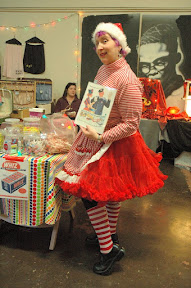
Another chance to shop local for some unique, vintage gifts for the holidays is going on right now (Sunday 12/11) until 6pm. In Cleveland Heights east of Lake Merritt is the latest of a number of popup markets around Oakland. This one is focused on vintage Christmas gifts, from old LPs (actual vinyl) to vintage clothes to photos of old signs. Tina Tamale (and the indefatigable Gil) of La Borinqueña are serving up yummy Tamales, and Monique of Semita Dulce is there with sweets.

There's lots of interesting, cool stuff for sale. It's even worth stopping by just to see the interesting art cars. Stop by, greet Miles Davis at the door, and hang out with some fun music playing.


More pictures:

Tuesday, August 9, 2011

Homespun Bikes

Homespun Bicycle

Apast Oakland sign entry as a different business, Homespun Bikes is not easy to categorize. Yep, they repair bikes, build custom frames, and sell bike accessories. But they also have compost, plant starts, classes on gardening, food preservation and other sustainable living skills.

They're next door to Leaning Tower of Pizza in the funky little commercial district off Lakeshore on Wesley.

Even if they had a business I wasn't likely to patronize, they got a lot of points from me for preserving the old Wesley Cleaners sign. They very carefully repainted the sign with the new name, and even documented the process. I stopped in to check them out, not thinking to buy anything, and came away with a cool USB-rechargeable headlight for my bike. The current one I have uses AA batteries, and doesn't last very long. The USB one has been amazing -- I want a tail light like it now, too.

In any event, if you're looking for bike accessories, a tune up, or some gardening advice near Lake Merritt, check out Homespun. Their next event is tomorrow (Wednesday) from 6:30-7:30, How to turn your weedy lot into an Organic Garden!


Sunday, July 17, 2011

food: Leaning Tower of Pizza

Leaning Tower of Pizza

It's nothing too fancy, but a good basic pizza can be had from Leaning Tower of Pizza. It's a small place next to Homespun Bikes (formerly Wesley Cleaners), and has a quiet, neighborhood vibe even though they're close to Lakeshore. They have the standard pizza toppings, plus some good combos. They serve beer (a selection of New Belgium beers on tap) and wine, as well as soft drinks.

I went there today after church to watch the Women's World Cup final. (That was an amazing game, even if the U.S. did lose. And I ran into a guy I worked with 15-20 years ago and hadn't seen since then. Which wasn't surprising, since he lives in Munich now.) It wasn't very busy, but there were probably 10 people there, most to watch the game. Some of the reviews on Yelp suggest it's a great spot to bring kids.

In any event, if you're in the neighborhood and looking for a good, basic pizza, check out Leaning Tower. It's on Wesley, just off Lakeshore, and is a quieter alternative to the bustle of Grand Avenue and the upper part of Lakeshore.

Monday, July 11, 2011

F.M. "Borax" Smith

Saturday was the first Oakland Heritage Alliance tour of the season, and was focused on Francis Marion "Borax" Smith. If you know anything about Oakland history, you've probably heard the name "Borax" Smith. After making a fortune in mining, Frank (as he was known to friends) switched his attention to real estate, and developed the Key System as a way to help develop and sell that real estate.

I have to admit I went in to the tour kind of wondering what we'd see. After all, the Smith Estate was long gone, so what was there to look at? While the house itself is gone, there are still remnants of the Smith's legacy. We couldn't have asked for a more knowledgeable tour guide than Phil Bellman, a long-time OHA member who has been leading these tours since the 80s. We met just off Park Blvd. across from where the mansion was.

Arbor Villa

The estate, known as Arbor Villa, was impressive. The grounds covered 50 acres. The house had 42 rooms, including 15 bedrooms, a bowling alley, and a miniature borax mine. While the house was on top of Ivy Hill, they also built an observation tower for what must have been stunning views.

While all that is gone, buildings that were around the estate and that were built after the estate was sold remain. There are some remarkable buildings, designed by the likes of Julia Morgan, Bernard Maybeck, and Clarence Dakin.

Frank and his first wife, Mary (Mollie) R. Smith were also known because of Mary's philanthropic work. Inspired by Benjamin Farjeon's Blade O'Grass, she started a home for "friendless" (i.e., orphaned) girls. Frank built a total of 13 cottages for the girls, plus the Home Club, which served as a community center, and turned over 34 acres to the Mary R. Smith Trust. A number of the cottages are still standing and are private residences now.

Along with amazing architecture and history about Smith, there were various interesting tidbits of Oakland history on the tour. One was an old sidewalk stamp at the corner of East 24th St. and 9th Ave, dating back to 1902. Our guide mentioned it was the oldest sidewalk stamp he knew of in Oakland. I immediately thought of the Oakland Sidewalk Stamps blog, and quickly found one as old. (With a little more searching on the site, I found ones dating to 1901). But what's remarkable is how little else was there in 1902, so having a sidewalk out in the boondocks was a big deal.

Evelyn Cottage
designed by Julia Morgan

After the tour was over, I walked and biked more around the neighborhood. I checked out F.M. Smith Park further down Park Blvd., which includes a plaque about Smith, statues of mules, and a grave marker for Smokey - a good mule. The park was built on land donated by the Smiths.

After getting some lunch and running some errands, I also stopped by a plaque in Trestle Glen that tells about the trestle built by Smith's Oakland Traction Company (a predecessor of the Key System). In 1893, they extended a streetcar line from downtown Oakland, up Park Boulevard, and built a large trestle across what was then Indian Gulch to carry picnickers to Sather Park. Mark Twain was one of the inaugural riders. The trestle lasted until 1906, when the streetcar was rerouted.

"Borax" Smith died in 1931, and is buried in Mountain View Cemetery, along "Millionaires Row".

Some other Smith-related Oakland sites:
Claremont Hotel - Built as a "destination" on the Key System by Smith's Realty Syndicate.
El Campanil - The clock tower at Mills College, donated by the Smiths, designed by Julia Morgan. One of the earliest structures built west of the Mississippi of reinforced concrete, it survived the 1906 earthquake unscathed, and furthered Morgan's career both as an architect and an engineer. (Various sources say it was the earliest, but see Phil's comment about earlier structures.)

See lots more photos here:

Wednesday, October 20, 2010

signs: Baggy's by the Lake

Baggy's by the Lake


Around the corner from the Parkway Theater and Woody's Laundromat is Baggy's by the Lake. I took the daytime pictures some time ago, but I've been waiting to post it until I had a chance to get a night shot. That's because during the day, it doesn't look like much. A closer look reveals a nice variation on the requisite drink glass, that even has a bit of color. And a nice-looking front door that bespeaks a bygone era. While the main sign is in good shape, the sign that hangs out for visibility up and down the street is broken.

at night


drink glass with color


awesome front door

Wednesday, October 6, 2010

signs: Wesley Cleaners

Wesley Cleaners

This lovely sign is not far from Lake Merritt, next to Leaning Tower of Pizza. It's a funny little commercial zone surrounded by apartments; if you stick to Lakeshore (which looks great these days -- loving the redone lanes and increased bike-friendliness) you'd never know it was there. Shout out to Only in Oakland for letting me know about it.

Wesley Cleaners